Why Does Your Pelvic Pain Have No Clear Cause? Understanding Pelvic Congestion Syndrome.
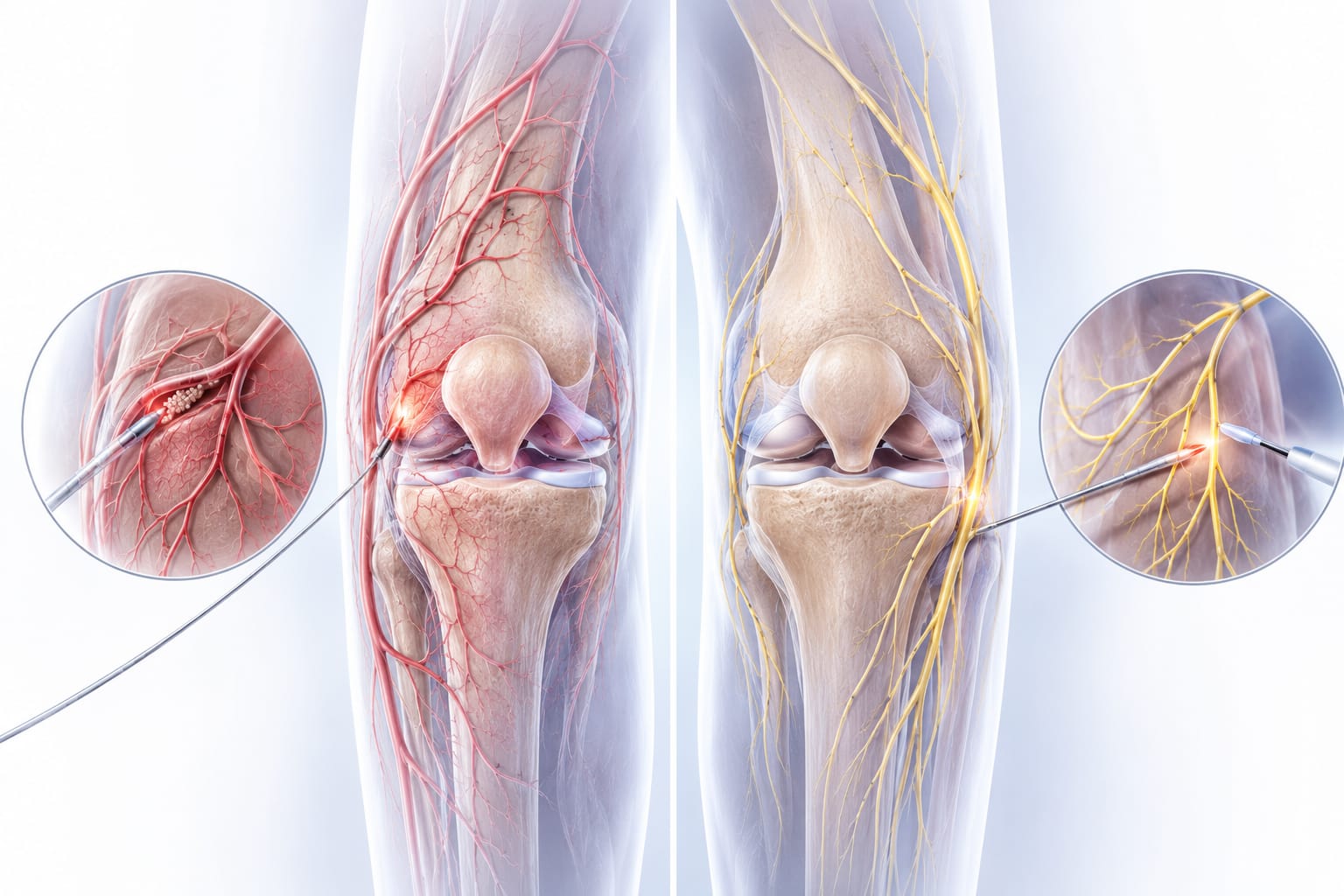
GAE vs Genicular Nerve Ablation: Which Non-Surgical Knee Pain Treatment Is Right for You?
If your knees hurt when climbing stairs, walking, or getting up after sitting, you may be looking for options beyond medication or knee replacement. Genicular Artery Embolization (GAE) and Genicular Nerve Ablation are two minimally invasive knee pain treatment options that work in different ways. Understanding how each procedure works, who may benefit, and what the current evidence shows can help you discuss the most appropriate option with your doctor.
What Is Genicular Nerve Ablation?
Genicular Nerve Ablation is a minimally invasive procedure that targets the small nerves around your knee joint that carry pain signals to your brain. Using heat generated by radiofrequency energy, the doctor numbs or “switches off” these specific nerves so the pain message simply stops getting through. It doesn’t fix the underlying arthritis or damage in the knee; it blocks the pain signal itself.
This may be considered for selected patients whose primary concern is chronic knee pain, particularly when conservative treatments have not provided adequate relief.
What Is GAE, and How Is It Different?
GAE targets abnormal blood vessels and inflammation associated with knee osteoarthritis, while genicular nerve ablation targets the nerves that transmit pain signals. GAE reduces abnormal blood flow to targeted vessels associated with inflammation around the knee, which may help reduce pain and other symptoms in appropriately selected patients.
By targeting abnormal vascularity associated with inflammation, GAE may help reduce knee pain and improve symptoms such as stiffness and swelling in appropriately selected patients.
The key difference is that genicular nerve ablation targets nerves that transmit pain signals, while GAE targets abnormal blood vessels associated with inflammation around the knee joint.

GAE vs Genicular Nerve Ablation: Quick Comparison
| Factor | Genicular Nerve Ablation | GAE |
|---|---|---|
| How it works | Targets genicular nerves that transmit pain signals | Targets abnormal blood vessels associated with inflammation |
| Main goal | Reduce transmission of pain signals | Reduce abnormal vascularity and inflammation |
| Potential benefits | Pain relief and improved function in selected patients | May reduce pain and improve symptoms in selected patients |
| Procedure type | Minimally invasive, image-guided | Minimally invasive, image-guided |
| Recovery | Usually performed as an outpatient procedure | Usually performed as an outpatient procedure |
| Long-term evidence | Evidence supports pain and function improvement, although results vary | Promising results, but long-term evidence is still developing |
This kind of side-by-side view is exactly the sort of knee pain treatment comparison most patients want before making a decision but it’s rarely explained this plainly.
Who May Be Considered for Genicular Nerve Ablation?
You may be a good candidate for genicular nerve ablation if:
- Chronic knee pain associated with osteoarthritis
- Persistent pain despite medication, physiotherapy, or other conservative treatments
- Patients who are not ready for, or may not be candidates for, knee replacement
- Patients seeking a minimally invasive approach to pain management
Suitability depends on clinical assessment, imaging findings, previous treatments and overall health.
Who May Be Considered for GAE?
GAE may be considered for selected patients with symptomatic knee osteoarthritis, particularly when conservative treatments have not provided adequate relief.
Possible considerations include:
- Persistent knee pain associated with osteoarthritis
- Symptoms that continue despite medication, physiotherapy or other conservative treatment
- Patients seeking a minimally invasive treatment option
- Patients who are not ready for, or may not be suitable for, knee replacement
GAE is not appropriate for everyone with knee pain. A specialist evaluation is necessary to determine whether it is suitable.
Benefits of Choosing Non-Surgical Knee Pain Options
For appropriately selected patients, minimally invasive treatments may offer advantages compared with major knee surgery:
- Often performed as an outpatient procedure
- Smaller access site compared with conventional surgery
- Generally less recovery time than major knee surgery
- Does not involve replacing the knee joint
- May provide an option for patients who want to delay or avoid knee replacement
The procedure, anesthesia, recovery and potential risks vary depending on the treatment and individual patient.

What Does the Evidence Say?
Both procedures have been studied as minimally invasive options for chronic knee pain, but they are supported by different levels and types of evidence. Genicular nerve ablation has clinical evidence showing improvements in pain and function for selected patients with knee osteoarthritis. GAE is also a promising treatment, but research is continuing to clarify which patients are most likely to benefit and how durable the results are.
This means neither treatment should automatically be considered better than the other. The appropriate option depends on the patient’s symptoms, imaging findings, previous treatments and overall health.
Is It Right for You?
The honest answer is – it depends on your specific knee, your imaging, and your symptoms, not just your age or how long you’ve had pain. A proper clinical evaluation, which may include a physical examination and imaging such as X-ray or MRI when appropriate, helps determine whether GAE, genicular nerve ablation or another treatment option is appropriate for you.
If conservative treatments have not provided adequate relief and knee replacement has been discussed, a consultation with an Interventional Radiologist can help you understand whether GAE, genicular nerve ablation or another minimally invasive option may be appropriate for your condition.
Book a consultation with Dr. Ram Kishore Gurajala to discuss your knee pain and available treatment options.

.jpg)
.png)
Comments
Post a Comment